NMKL News No. 108 Dec 2024 published
The NMKL Newsletter issued 4 December 2024 is published and available here:
NMKL News No. 108 (Sway)

The NMKL Newsletter issued 4 December 2024 is published and available here:
NMKL News No. 108 (Sway)
NMKL 189 has been revised and split into two separate method parts, NMKL 189 A and NMKL 189 B:
The NordVal certificates 034, 035 and 036 issued to Shimadzu Diagnostics Corporation for Compact Dry methods were renewed and are valid until 1 Dec 2026.
NordVal 034 Compact Dry ETB is a ready-to-use selective plate containing glucose for the enumeration of Enterobacteriaceae in a broad range of foods.
NordVal 035 Compact Dry CF is a ready-to-use chromogenic plate for the enumeration of total coliforms in a broad range of foods.
NordVal 036 Compact Dry EC is a ready-to-use dry chromogenic plate for enumeration of E. coli and coliforms in a broad range of foods.
The certificate NordVal 032, issued to Bio-Rad Laboratories, was extended to pet food and animal feed (375 g test portion), and is valid until 1 Dec 2026.
RAPID’Salmonella is a chromogenic agar medium for detecting Salmonella in different matrices (see below), the principle of which relies on demonstration of two enzymatic activities. The RAPID’Salmonella plates can be stored for 72 h at 5°C ± 1°C before reading.
The RAPID’Salmonella method – short protocol is applicable to
• a broad range of foods (25 g test portions),
• milk powders including infant formula (with and without probiotics), and related dehydrated dairy ingredients (375 g test portion)
• infant formula and infant cereals with or without probiotics including ingredients (375 g test portion)
• Pet food and animal feed products (25 g and 375 g test portions)
The RAPID’Salmonella method – double enrichment protocol is applicable to dairy products (excluding raw milk).
The NordVal certificate NordVal 056 Microbiologique Salmonella IEH Test Kit, issued to Microbiologique Inc., is applicable for the detection of Salmonella spp. in raw milk and dairy products, raw and ready to eat meat products, eggs and egg products, fish and seafood, multicomponent foods, and environmental samples. The method includes cultural enrichment followed by PCR assays.
The certificate was renewed for 2 years until 17 October 2026.
A NordVal International certificate valid until 14 Oct 2026 was issued to Kikkoman Biochemifa Company for Easy Plate YM-R for enumeration of yeasts and moulds in food, feed and environmental samples.
The method is a prepared microbiological culture device made up of a waterproof sheet, a dry medium on the sheet and a transparent cover over the medium. 1 ml volumes of appropriately diluted samples are plated onto the YM-R plates, allowed to soak in and then incubated. Yeasts tend to form small colonies with defined edges, and moulds tend to form colonies with diffuse edges.
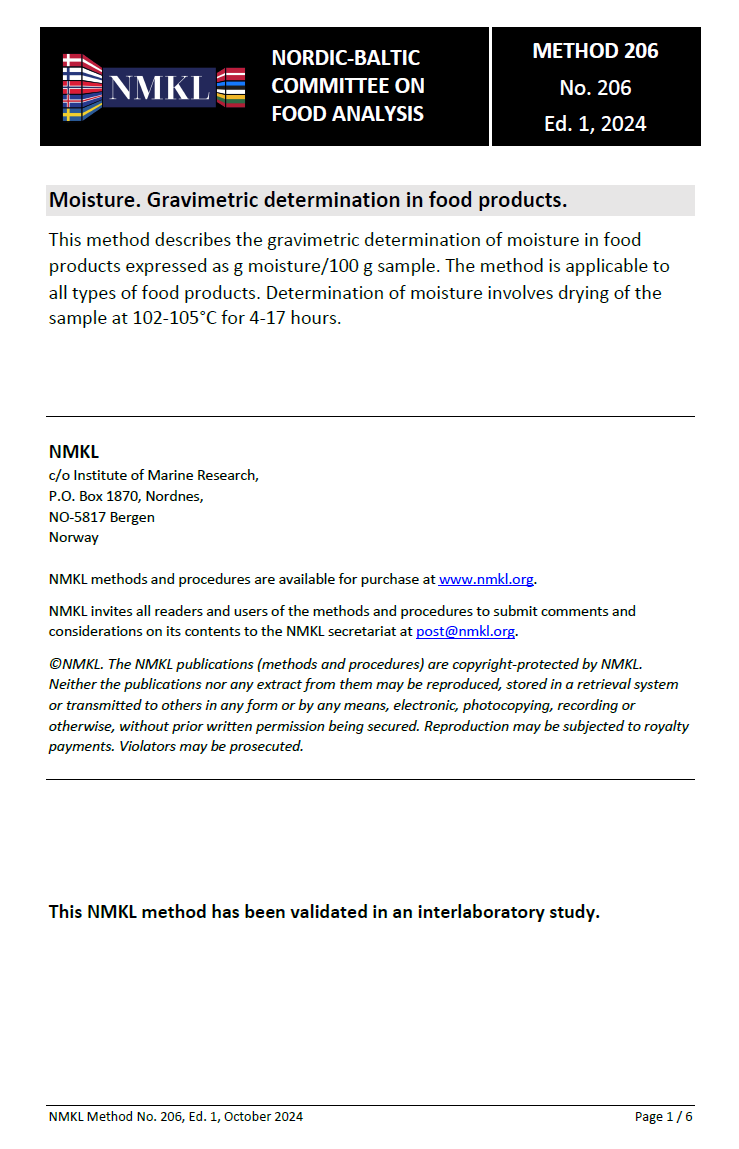
NMKL 206. Year 2024, Ed. 1. Moisture. Gravimetric determination in food products.
This method describes the gravimetric determination of moisture in all types of food products. Determination of moisture involves drying of the sample at 102-105°C for 4-17 hours. This NMKL method has been validated in an interlaboratory study.
Historical note: The method NMKL 23 Ed. 3, 1991. ‘Moisture and ash. Gravimetric determination in meat and meat products’ was considered redundant by NMKL in 2005 when NMKL 173 Ed. 2, 2005. ‘Ash, gravimetric determination in foods’ was published. NMKL 23 was withdrawn 16 Sept 2022 and was replaced by this method 4th of October 2024.
The NordVal certificate NordVal 037 iQ-Check® Listeria monocytogenes II, issued to Bio-Rad Laboratories, is as a qualitative method allowing the detection of Listeria monocytogenes in a broad range of foods and in environmental samples.
The certificate was renewed for 2 years until 01 October 2026.
NordVal 037 iQ-Check® Listeria monocytogenes II
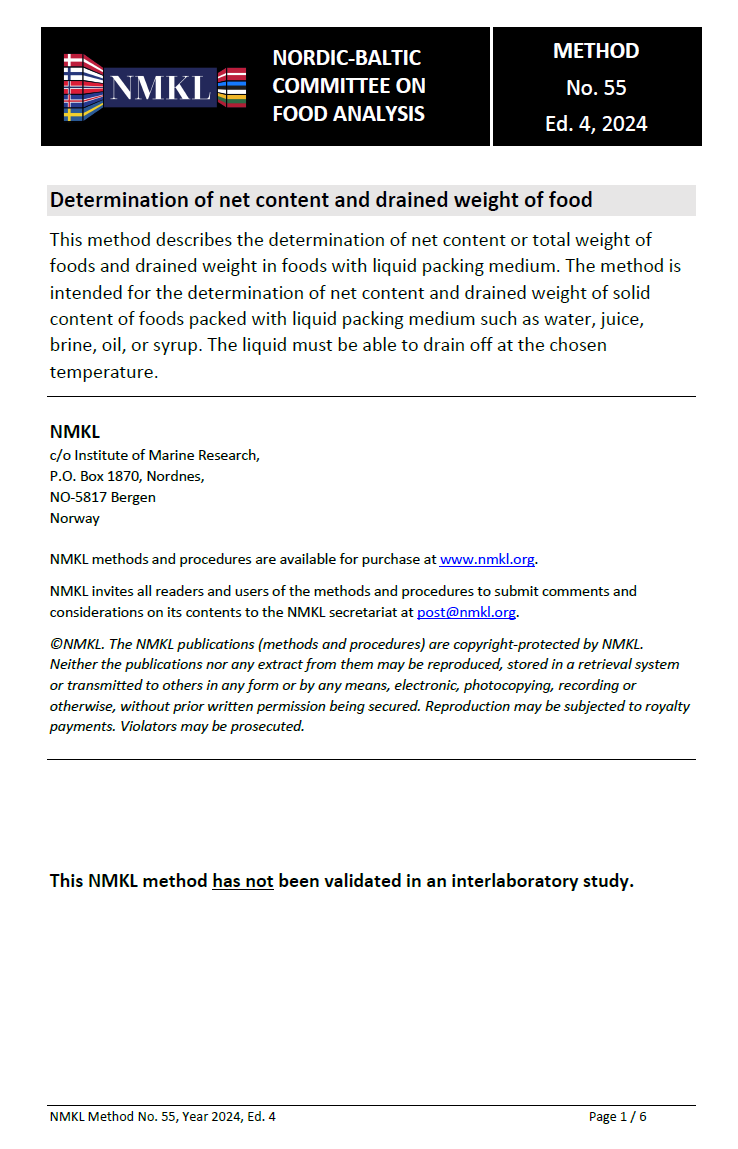
NMKL 55 Determination of net content and drained weight of food, Year 2024, Ed. 4 was published 20.08.2024.
This method describes the determination of net content or total weight of foods and drained weight in foods with liquid packing medium. The method is intended for the determination of net content and drained weight of solid content of foods packed with liquid packing medium such as water, juice, brine, oil, or syrup. The liquid must be able to drain off at the chosen temperature.
This NMKL method has not been validated in an interlaboratory study.
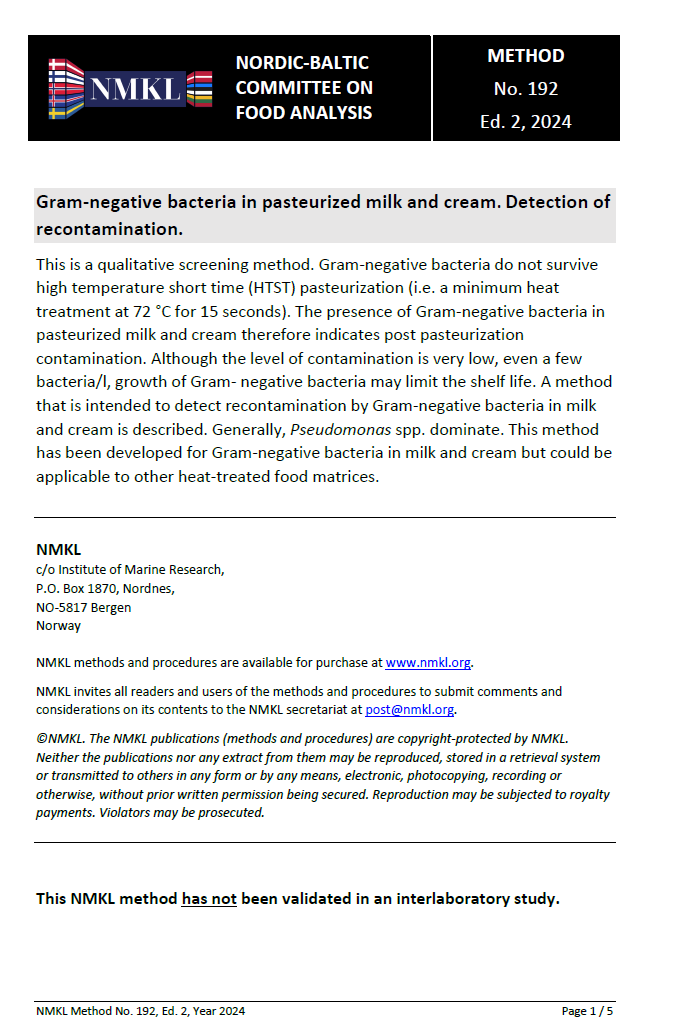
NMKL 192 Ed. 2 2024. Gram-negative bacteria in pasteurized milk and cream. Detection of recontamination.
This is a qualitative screening method. Gram-negative bacteria do not survive high temperature short time (HTST) pasteurization (i.e. a minimum heat treatment at 72 °C for 15 seconds). The presence of Gram-negative bacteria in pasteurized milk and cream therefore indicates post pasteurization contamination. Although the level of contamination is very low, even a few bacteria/l, growth of Gram- negative bacteria may limit the shelf life. A method that is intended to detect recontamination by Gram-negative bacteria in milk and cream is described. Generally, Pseudomonas spp. dominate. This method has been developed for Gram-negative bacteria in milk and cream but could be applicable to other heat-treated food matrices.
This NMKL method has not been validated in an interlaboratory study.